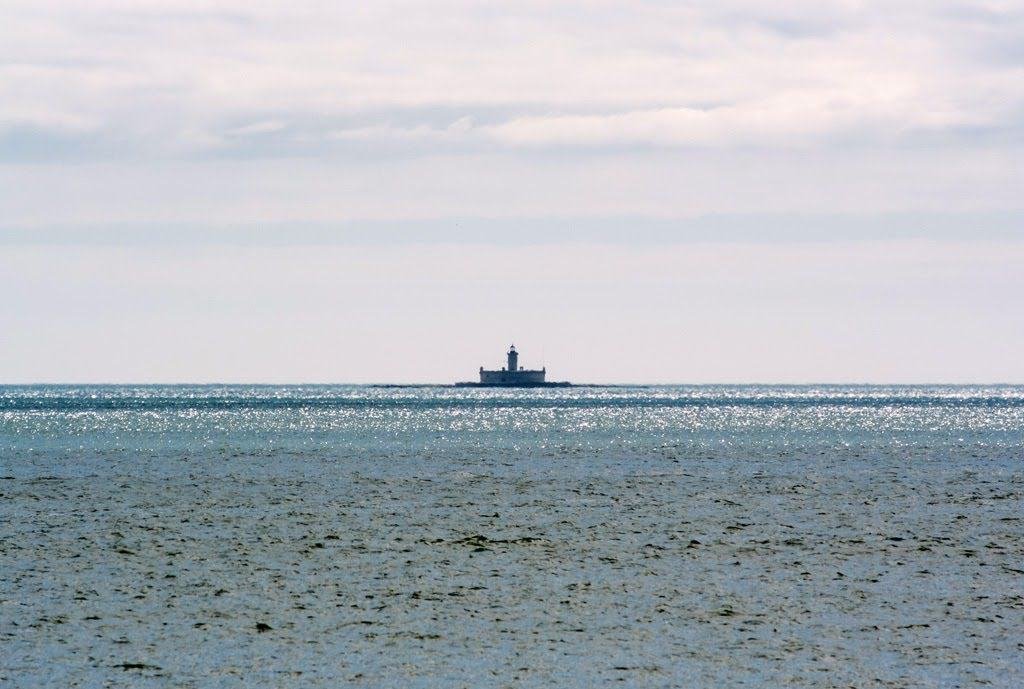
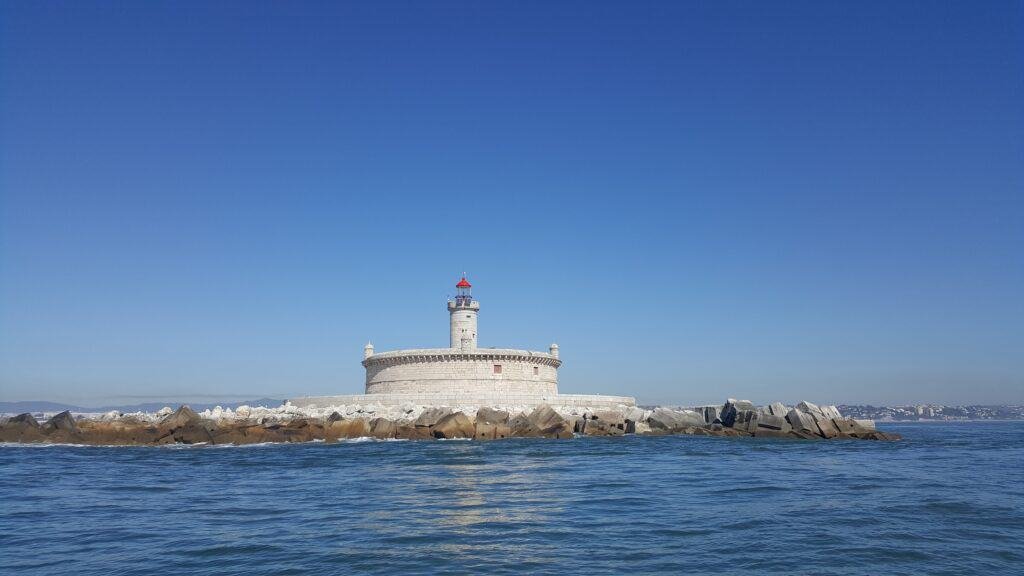
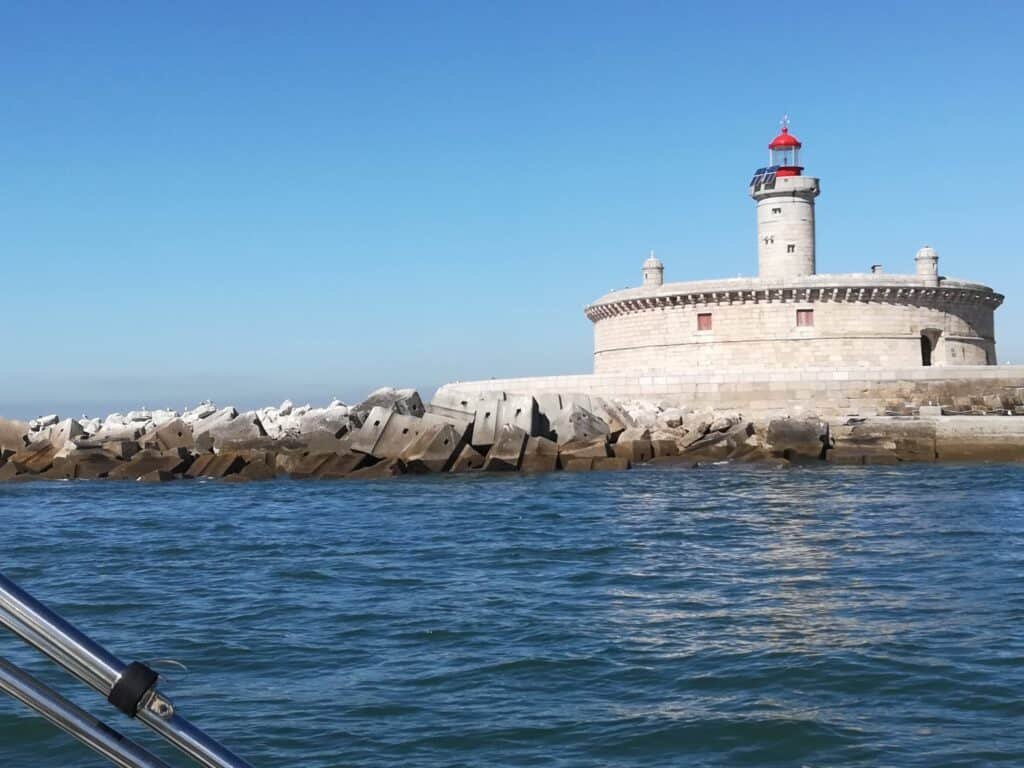
The Bugio Lighthouse, also known as São Lourenço da Cabeça Seca Fort, was built in the 16th century and is a historical and cultural monument located in Lisbon. This lighthouse has a long history and is known for its privileged location in the middle of the waters of the Tagus River estuary.
The place where it stands is a sandbank formed by the silting up of the river mouth, the result of the confluence of its waters with those of the Atlantic Ocean, to the rhythm of the tides.
The toponymy howler can be attributed, among other versions, to the French bougie (candle), due to the similarity of its circular structure and the primitive tower topped by a lighthouse, with a lighted candle on its candlestick.
The structure of the fortification is made up of:
- The outer wall (with a circular base, 62 meters in diameter and 6 meters high) is divided by an arched doorway;
- Inner wall (circular in shape, 33 meters in diameter and 7 meters high);
- The central tower (circular in shape, 3 meters in diameter and 16 meters high) has an arched doorway. At the top of the tower is the modern lighthouse;
- Command house, barracks, armory, storerooms, cistern and chapel.
How it all began
Initially, the idea of a fortification for the mouth of the Tagus River was presented, with the function of protecting maritime access to the city of Lisbon, during the reign of King Sebastian (1568-78), by the architect Francisco de Holanda. Thus, the sovereign accepted this suggestion, ordering, in 1578, D. Manuel de Almada to erect this structure, with the strategic function of crossing fire with the Fort of São Julião da Barra (at the time, known as the Tower of São Gião) also part of the city’s defensive scheme.
And it evolved
With the succession crisis that occurred after the king’s death at the Battle of Alcácer-Quibir, and with the possibility of an invasion of Portugal by the troops of Philip II of Spain, it was decided to build a small structure. It was erected on wooden piles which, filled with stones, served as the foundation for a platform with artillery pieces.
Now under Spanish rule
In 1580, after surrendering to the Spanish armada, it was subsequently disarmed. The fragility of the materials used, combined with the instability of the sandbank and the action of currents and tides, soon irreparably compromised this structure.
Already in 1586, during the Philippine Dynasty, King Philip I commissioned a study to improve the defensive system of the Lisbon bar, which was under threat from English and Dutch corsairs. Four years later, two fortification projects were presented to the sovereign, with Philip I opting for the scheme that presented a circular shape. That is, it was a more solid fortification in the face of the dynamics of the waters and allowed better positioning of the artillery.
In 1593, the laying of the stones that would serve as foundations underwater was completed. Thus, for the preparation of the stone blocks used in the foundation and walls, a construction site was erected on land, near São Julião da Barra.
From 1598, the military engineer and Italian architect Leonardo Torriani took over the direction of the work. This was when the project entered a new phase, given the changes that Torriani introduced, expanding it.
Until it returned to Portuguese hands
At the Restoration of Independence on December 1, 1640, it was still under construction, but already garrisoned and armed. Assuming the throne as King John IV (1640-1656), this sovereign determined that the works should be completed and that a Portuguese engineer should take over the work (1643). Thus began a new construction phase, under the superintendence of the Count of Cantanhede, being completed in 1657.
The inspection report carried out on the lighthouse in 1751 shows that it operated with oil and was in reasonable condition. This structure, destroyed by the 1755 earthquake, was rebuilt as one of the six lighthouses erected on the Portuguese coast to aid navigation, as determined by the Marquis of Pombal in 1758. The new lighthouse came into operation in 1775.
20th and 21st centuries
The Maritime Museum in Lisbon and the Naval Museum of Almada frequently present exhibitions on the lighthouse system in Portugal, including models and historical documentation relating to the Bugio Lighthouse
Importance of the Bugio Lighthouse for maritime safety
Despite its heritage value, the Bugio Lighthouse continues to have a practical function:
- Automated system: The Bugio Lighthouse has been restored several times over the centuries. Since the 1980s, the lighthouse has operated with an automated system, remotely controlled by the Lighthouse Directorate of the Portuguese Navy.
- Aid to modern navigation: It is a fundamental reference point for vessels entering and leaving the port of Lisbon, both for international cruises and for cargo and fishing vessels.